
Ships anywhere in the United States
Grass fed beef sticks from a ranch you can drive to.
Most beef sticks are made by companies that buy beef. This one is made by the family that raised the animal, and smoked twenty minutes down the road. Shelf stable, so we can post them to any state.
Three ingredients
| Beef | Grass fed and grass finished in Heber Springs, Arkansas, from this herd |
|---|---|
| Red wine vinegar | The cure. It does the job that nitrates and cultured celery powder do in most snack sticks |
| Sea salt | For flavor and for keeping. That is its whole job |
That is the list. No sugar, no dextrose, no cultured celery powder, no binders, and no organ meat blended in and masked. If you have ever turned a snack stick over and needed a second to work out what half of it was, you already know why that matters.
Are grass fed beef sticks healthy?
Most brands answer this by changing the subject. We will give you the honest version.
A beef stick is a cured, smoked snack. It is salty, because salt is what keeps it. Nobody should pretend otherwise. What you can control is everything else in the package, and that is where the difference sits. Ours has three ingredients. A lot of what sits beside it on the shelf carries sugar to balance the cure, dextrose to feed the ferment, cultured celery powder so the label can avoid the word nitrate, and binders to hold a cheaper grind together.
We are not making a health claim. We are making a plainness claim. You can read our whole ingredient list out loud without stopping.
What to look for on any beef stick label
- Where the beef is from. Most brands will name a farming philosophy but not a country. If a package says regenerative and will not say where, that is a choice somebody made.
- Grass fed or grass finished. Nearly all cattle are grass fed for most of their lives, so that phrase alone tells you very little. Finished is the word that carries information.
- Sugar under another name. Dextrose, cane sugar, maple, honey. All of it is sugar doing a job in the cure.
- Cultured celery powder. It is a nitrate source that lets a label say no added nitrates. It is not wrong, but it is not nothing either.
- Organs. Some brands blend liver and heart in and work to make them undetectable. If you want that, it is a feature. If you want beef, it is not.
How ours compare to the national brands
The big grass fed brands make a good stick. We are not going to pretend otherwise. What they will not do is tell you where the beef came from. The usual wording is farms across several countries, which means nobody can tell you which animal is in the package they are holding.
That is the entire supply chain, and you can visit all three.
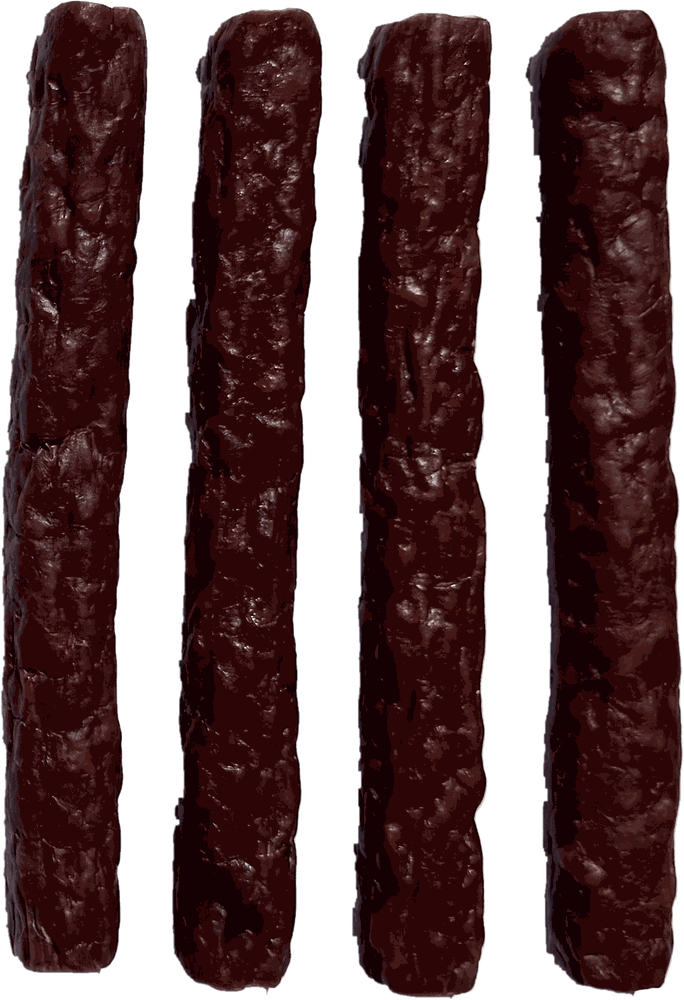
Set side by side under the same light, ours run about 30% thicker across the stick. That is not a nutrition claim. It is just what the two look like next to each other.
Where the beef actually comes from
South Poll cattle, born, raised and grass finished on our ground outside Heber Springs, in Cleburne County, Arkansas. When a batch is made it comes from specific animals off this ranch, not from a pool of beef bought on a commodity market. Ask which pasture and there is an answer.
If you want to understand why the finishing matters more than the raising, we wrote a longer piece on what grass finished actually means. And if you are comparing brands, our buyer's guide explains what to look for on any label, not just ours.
Getting them to you
| Where we ship | Anywhere in the United States. Shelf stable, so no cold box and no rush freight. |
|---|---|
| Bulk and cases | Gyms, offices, job sites, hunting camps and shops. Call the ranch and we will quote it. |
| Local pickup | Sundays at the ranch, nothing to pay for shipping. |
Sticks are the one thing we make that travels well. The fresh beef and shares stay within about 300 miles of Heber Springs, because frozen beef has to move fast and cold.
How to get some
- Put your name on the list below, or call the ranch.
- We tell you the day a batch comes out of the smokehouse.
- It ships to your door, or you collect it here on a Sunday.
Batches are small because one animal only makes so many. When they are gone they are gone until the next one, and the list hears first.
Questions we get
Are grass fed beef sticks healthy?
That depends what you mean, and most brands dodge the question. Ours are beef, red wine vinegar and sea salt. There is no sugar, no dextrose, no cultured celery powder, no binders and no fillers. We are not going to tell you a snack stick is medicine, but you can read the whole ingredient list in about four seconds.
What is in the beef sticks?
Beef, red wine vinegar and Redmond sea salt. Three ingredients.
Are they really grass finished?
Yes. The cattle are finished on our own pasture on grass. They never go to a feedlot and they are never switched to grain, which is what happens to most cattle in the final months.
Where are they made?
At a smokehouse in Letona, Arkansas, from beef raised on our ranch outside Heber Springs. The two are about twenty minutes apart.
Do you ship beef sticks nationwide?
Yes, to any state. They are shelf stable so they travel by ordinary post with no cold box. Our fresh beef is different and stays within about 300 miles of the ranch.
Do you sell them in bulk?
Yes. Call the ranch for case pricing. People buy them by the case for gyms, offices, job sites and hunting camps.
How long do they keep?
Ask us for the batch you are buying. We would rather give you the real date on the real run than a general number that might not apply.
Rather just ask somebody?
Call the ranch and you will get Justin or Ryley, not a call center. Ask anything about the cattle, the cuts, a share, or when the next batch is ready.
The sticks are not in the store yet. Beef, brats and eighth and half shares are available now. Put your name down and you will hear the day sticks go up.
Shop what is availableSticks are made in batches. Get on the list.
One animal makes a limited run. When a batch is ready, the list hears first.
We will tell you when beef is ready. Nothing else.